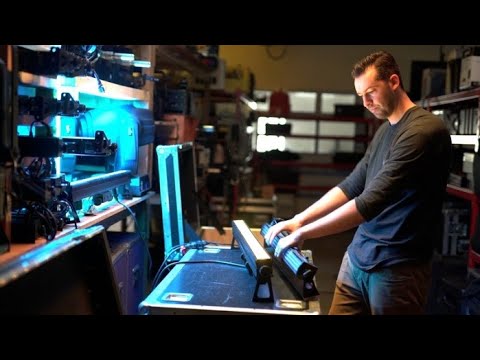
Audio and video recording technicians
Career Overview
Audio and video recording technicians operate equipment to record, mix and edit sound, music and videotape for motion pictures, television and radio programs, videos, recordings and live events.
People in this career:
- Work for film, video and concert production companies, sound recording firms, theatre and dance companies, clubs, bands, multimedia companies, radio stations, television networks and video production and editing companies
- Must have good manual dexterity and an aptitude for working with electrical, electronic, and mechanical systems and equipment
- Should have mathematical ability
- Should be physically fit and able to lift heavy objects
- Should be comfortable working at heights
- Should also have the ability to work both independently and as part of a team
Job Titles
Duties
Audio and video recording technicians perform some or all of the following duties:
- Set up, prepare, operate and adjust audio, recording, editing and reproducing equipment to record, edit and reproduce sound input or feed of pre-recorded material from tapes, records, compact discs, digital audio devices, and input from live microphones, satellites or microwave trucks for films, videos, radio and television programs and recordings
- Prepare and operate videotape recording and playback equipment to record videos, television programs, concerts and live events, and to edit video tape after production
- Operate electronic equipment to generate program titles, credits, subtitles, graphic backgrounds or animation for television programs
- Operate audio consoles or computers, tape machines, microphones and sound processing equipment to mix, combine and edit music and sound at concerts and live events
- Operate dubbing machines to play back edited dialogue, music and sound effect tracks from different sources, in synchronization with motion picture film
- May supervise and coordinate the work of other audio and video recording technicians
Earnings
Earnings is income that workers receive in exchange for their labour. Depending on the type of employment, earnings can be in the form of wages (hourly), salaries (fixed monthly or annual) or self-employed earnings.
Work Environment
# Workers Employed
2,505% Employed Full Time
41%Audio and video recording technicians work indoors in small sound studios or at live events, such as concerts, meetings and conferences. Travel is required in order to work on location.
Audio and video recording technicians who work at large stations or networks usually work 40 hours per week, with occasional overtime. Those who work on motion pictures may be on a tight schedule and work long hours to meet deadlines.
Career Pathways
With appropriate education and experience, audio and video recording technicians may progress to senior or supervisory positions (i.e., recording and sound engineers) or start their own businesses.
Occupational Interests
It’s important to understand what kinds of occupations align with your interests.
For more about occupational interests visit Skills for the Future Workforce > Characteristics.
Here are the top occupational interest(s) for this career profile:

Education, Training and Skills
Completion of a one- to three-year certificate, diploma or degree program in audio and video recording or a related program is required. Paid or volunteer experience as a recording studio assistant is also usually needed.
Education programs in B.C.

Top Skills
Every job calls for a certain set of skills. Knowing those skills is the first step in finding a good career fit.
Here, you will find the 10 most relevant workplace skills. Some are more important to achieving success in a certain career than others. These skills may come naturally to you or you may need to gain them through education, training and experience.
See the list of work-related skills below, ranked in order of importance for this career. Check out the list and see if this career matches your skills—take that first step!

Understanding written sentences and paragraphs in work-related documents.

Keeping track of and assessing your performance, other individuals, or organizations to make improvements or take corrective action.

Giving full attention to what other people are saying, taking time to understand the points being made, asking questions as appropriate, and not interrupting at inappropriate times.

Using logic and reasoning to identify the strengths and weaknesses of alternative solutions, conclusions or approaches to problems.

Talking to others to share information effectively.

Watching gauges, dials or other indicators to make sure that a machine is working properly.

Being able to solve novel, ill-defined problems in complex, real-world settings.

Communicating effectively in writing as appropriate for the needs of the audience.

Adjusting actions in relation to others' actions.

Understanding how new information could be used to solve current and future problems in making decisions.
Labour Market Statistics
Discover data, facts and information that have been gathered and analyzed. Learn about the characteristics of the economy and labour market in B.C.
Employment
Find out about employment types and trends by region and industry.
Employment
2,505Employment by Region

| Region | Employment | % Employment of this Occupation |
|---|---|---|
| Cariboo | 15 | 0.6% |
| Kootenay | 40 | 1.6% |
| Mainland/Southwest | 2,065 | 82.3% |
| North Coast and Nechako | 15 | 0.6% |
| Northeast | 0 | 0.0% |
| Thompson-Okanagan | 105 | 4.2% |
| Vancouver Island/Coast | 275 | 11.0% |
Labour Market Outlook
The B.C. Labour Market Outlook is a 10-year forecast of the expected supply and demand for labour in the province. It’s usually updated every year. The purpose is to provide British Columbians with the knowledge to make informed decisions on careers, skills training, education and hiring.
Forecasted Job Openings (2025-2035)
1,020Forecasted Job Openings
Forecasted Employment Growth Rate
Composition of Job Openings
Job Openings by Region (2025-2035)
| Region | Job Openings | Avg. Annual Employment Growth |
|---|---|---|
| Cariboo | Not available | Not available |
| Kootenay | 0 | -0.2% |
| Mainland/Southwest | 840 | 1.4% |
| North Coast and Nechako | Not available | Not available |
| Northeast | Not available | Not available |
| Thompson-Okanagan | 30 | 1.7% |
| Vancouver Island/Coast | 150 | 2.0% |
Industry Highlights
Learn about the opportunities in B.C.'s major industries, including employment trends, earning potential, locations of work and more.
Forecasted Job Openings by Industry
| Industry | Job Openings (2025-2035) |
|---|---|
| Information, Culture and Recreation | 650 |
| Professional, Scientific and Technical Services | 170 |
| Educational Services | 50 |
| Repair, Personal and Non-Profit Services | 40 |
| Construction | 20 |
Resources
-
Academy of Canadian Cinema and Television (ACCT)www.academy.ca
-
Canadian Association of Broadcasterswww.cab-acr.ca
-
Canadian Media Producers Association (CMPA)www.cmpa.ca
Career Videos
Watch the video below to learn what a typical day is like for an audio video technician.
Watch the video below to learn what a typical day is like for an audio video technician.