Opticians

 High opportunity occupation
Career Overview
Opticians are health professionals who interpret prescriptions, fit and dispense eyewear and, in B.C., may also be certified to conduct sight tests to assess visual acuity. This includes helping patients select eyeglass frames, arranging the production of eyeglasses or contact lenses and mounting lenses in eyeglass frames, in both clinical and retail settings. Student opticians and opticians who are managers of optical retail outlets and eye clinics are included in this group. This role demands analytical and interpersonal skills as well as computer knowledge.
Job Titles
Duties
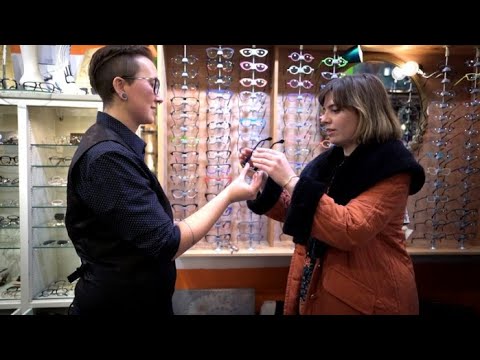
Opticians help people correct their vision by creating and fitting eyeglasses and contact lenses. They use prescriptions from eye doctors or measure a person’s eyes and current lenses to determine what they need. They also guide people in choosing frames, lens materials, coatings and tints and teach them how to use and care for contact lenses.
As part of a vision care team, opticians can order and shape lenses, fit them into frames and adjust finished glasses so they’re comfortable. Many opticians also supervise other opticians or students.
Opticians are health professionals first and salespeople second. They can identify eye abnormalities and refer patients to optometrists or ophthalmologists for more advanced care. They can also troubleshoot vision problems related to contact lens intolerance and complex lens designs such as progressive lenses.
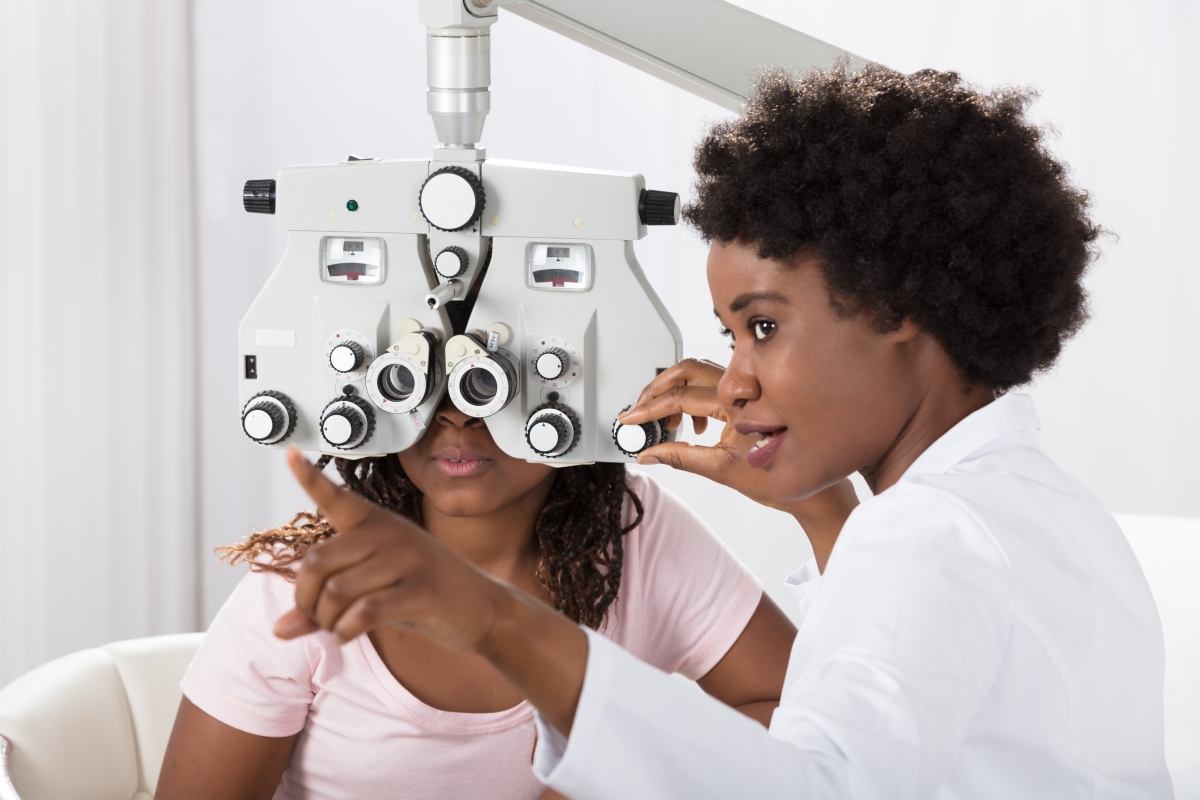
British Columbia is a leading jurisdiction in expanding the duties and scope of practice of opticians. In particular, the Certified Refracting Optician in BC certification enables opticians to perform automated refraction (sight testing). This helps optometrists meet the increasing demand for vision tests.
Opticians are increasingly acting as the primary facilitator for tele-optometry services, operating the imaging and diagnostic technology that allows remote optometrists to examine patients.
Earnings
Earnings is income that workers receive in exchange for their labour. Depending on the type of employment, earnings can be in the form of wages (hourly), salaries (fixed monthly or annual) or self-employed earnings.
Work Environment
# Workers Employed
1,345% Employed Full Time
43%Opticians work in clinical settings, independent dispensaries and collaborative care clinics, often alongside optometrists and ophthalmologists. These are typically well-lit, comfortable indoor locations. In addition to an area that resembles a storefront and an area for performing optical exams, an optician’s workplace is increasingly likely to include advanced digital measuring devices, retinal imaging equipment, and other tools of optical science.
Career Pathways
Opticians usually begin work as student opticians during the practica that are part of their studies. Once licensed through NACOR, they become eligible for ordinary optician positions. Most new opticians join an established optician’s practice. Opticians can advance to Certified Contact Lens Fitter and Certified Refracting Optician (Sight Tester) via additional certifications.
After gaining experience, opticians often advance to dispensary or regional manager and practice / independent business owner positions, taking over more responsibilities at their practices. They may also gain regulatory or association leadership roles at relevant colleges or regulatory bodies such as the College of Health and Care Professionals of BC (CHCPBC) or become a representative of an eyecare supply or pharmacy company.
Occupational Interests
It’s important to understand what kinds of occupations align with your interests.
For more about occupational interests visit Skills for the Future Workforce > Characteristics.
Here are the top occupational interest(s) for this career profile:


Education, Training and Skills
Becoming a licensed optician requires completion of an accredited optician program at an institution recognized by the College of Health and Care Professionals of British Columbia (CHCPBC). These are typically two-year diploma programs that include laboratory and clinical practica. Graduates must also pass a national licensing examinations administered by the National Alliance of Canadian Optician Regulators (NACOR) to become a Registered Optician.
The NACOR exam has two parts. Passing the first grants the Registered Optician – Eyeglass Dispensing certification; passing the second grants the Registered Optician – Contact Lens and Eyeglass Dispensing certification. Although only the Registered Optician – Eyeglass Dispensing certification is required to practice as an optician in B.C., certification in contact lens fitting is highly desirable and improves both employment prospects and earning potential. Similarly, opticians in B.C. are also highly encouraged to pursue the Refraction (Sight Testing) Certification offered by CHCPBC after their NACOR certifications.
Licensed opticians who are certified by a regulator elsewhere in Canada can apply for the same certification from the regulator in B.C. Under the terms of the Canadian Free Trade Agreement (CFTA), most applicants who are transferring their credentials from elsewhere in Canada will not be required to complete additional training or testing. However, thanks to the national-level certification offered by NACOR, this is usually not necessary.
For information about labour mobility in Canada, visit www.workersmobility.ca.
For those who trained outside of Canada and never received certification from any Canadian jurisdiction, a full assessment is likely needed. Most occupational regulators have a process for assessment and recognize internationally trained applicants.
Contact the College of Health Professionals of British Columbia for details on how to apply for certification in B.C.
View a list of Professional Regulatory Authorities in B.C.
Education programs in B.C.

Top Skills
Every job calls for a certain set of skills. Knowing those skills is the first step in finding a good career fit.
Here, you will find the 10 most relevant workplace skills. Some are more important to achieving success in a certain career than others. These skills may come naturally to you or you may need to gain them through education, training and experience.
See the list of work-related skills below, ranked in order of importance for this career. Check out the list and see if this career matches your skills—take that first step!

Talking to others to share information effectively.

Giving full attention to what other people are saying, taking time to understand the points being made, asking questions as appropriate, and not interrupting at inappropriate times.

Understanding written sentences and paragraphs in work-related documents.

Using logic and reasoning to identify the strengths and weaknesses of alternative solutions, conclusions or approaches to problems.

Actively looking for ways to help people.

Communicating effectively in writing as appropriate for the needs of the audience.

Adjusting actions in relation to others' actions.

Convincing others to change their mind or behaviour.

Being aware of others’ reactions and understanding why they react as they do.

Understanding how new information could be used to solve current and future problems in making decisions.
Labour Market Statistics
Discover data, facts and information that have been gathered and analyzed. Learn about the characteristics of the economy and labour market in B.C.
Employment
Find out about employment types and trends by region and industry.
Employment
1,345Employment by Region

| Region | Employment | % Employment of this Occupation |
|---|---|---|
| Cariboo | 40 | 3.0% |
| Kootenay | 20 | 1.5% |
| Mainland/Southwest | 885 | 65.8% |
| North Coast and Nechako | 10 | 0.7% |
| Northeast | 0 | 0.0% |
| Thompson-Okanagan | 185 | 13.8% |
| Vancouver Island/Coast | 205 | 15.2% |
Labour Market Outlook
The B.C. Labour Market Outlook is a 10-year forecast of the expected supply and demand for labour in the province. It’s usually updated every year. The purpose is to provide British Columbians with the knowledge to make informed decisions on careers, skills training, education and hiring.
Forecasted Job Openings (2025-2035)
660Forecasted Job Openings
Forecasted Employment Growth Rate
Composition of Job Openings
Job Openings by Region (2025-2035)
| Region | Job Openings | Avg. Annual Employment Growth |
|---|---|---|
| Cariboo | 10 | -0.1% |
| Kootenay | 10 | 1.5% |
| Mainland/Southwest | 450 | 1.3% |
| North Coast and Nechako | Not available | Not available |
| Northeast | Not available | Not available |
| Thompson-Okanagan | 90 | 1.4% |
| Vancouver Island/Coast | 90 | 1.0% |
Industry Highlights
Learn about the opportunities in B.C.'s major industries, including employment trends, earning potential, locations of work and more.
Forecasted Job Openings by Industry
| Industry | Job Openings (2025-2035) |
|---|---|
| Retail Trade | 410 |
| Health Care and Social Assistance | 240 |
| Manufacturing | 10 |
Insights from Industry
B.C. faces a shortage of opticians, which is most acute in rural regions. There is a significant increase in demand due to an aging population and increasing demand for vision care. Opticians are increasingly bridging the gap in access to vision care, especially in rural areas, where the lack of consistently available optometrists may make opticians a vital source of sight tests and contact lens services. Opticians certified in contact lens fitting and refraction (sight testing) are in particularly high demand, which the output of optician schools has not yet risen to meet.
Resources
-
National Association of Canadian Optician Regulators (NACOR)www.nacor.ca/
-
Opticians Association of Canada (OAC)www.opticians.ca/
-
Opticians Association of Canada, British Columbia Chapterwww.opticians.bc.ca/
-
Opticians Council of Canadabecomeanoptician.com/
-
College of Health and Care Professionals of BC (CHCPBC)chcpbc.org/
-
Douglas College (Dispensing Optician Program)www.douglascollege.ca/programs-and-courses/areas-study/science-and-technology/opticianry
-
Stenberg Collegestenbergcollege.com/program/licensed-optician/
Career Videos
Watch the video below to learn what a typical day is like for am optician.
Watch the video below to learn what a typical day is like for am optician.