
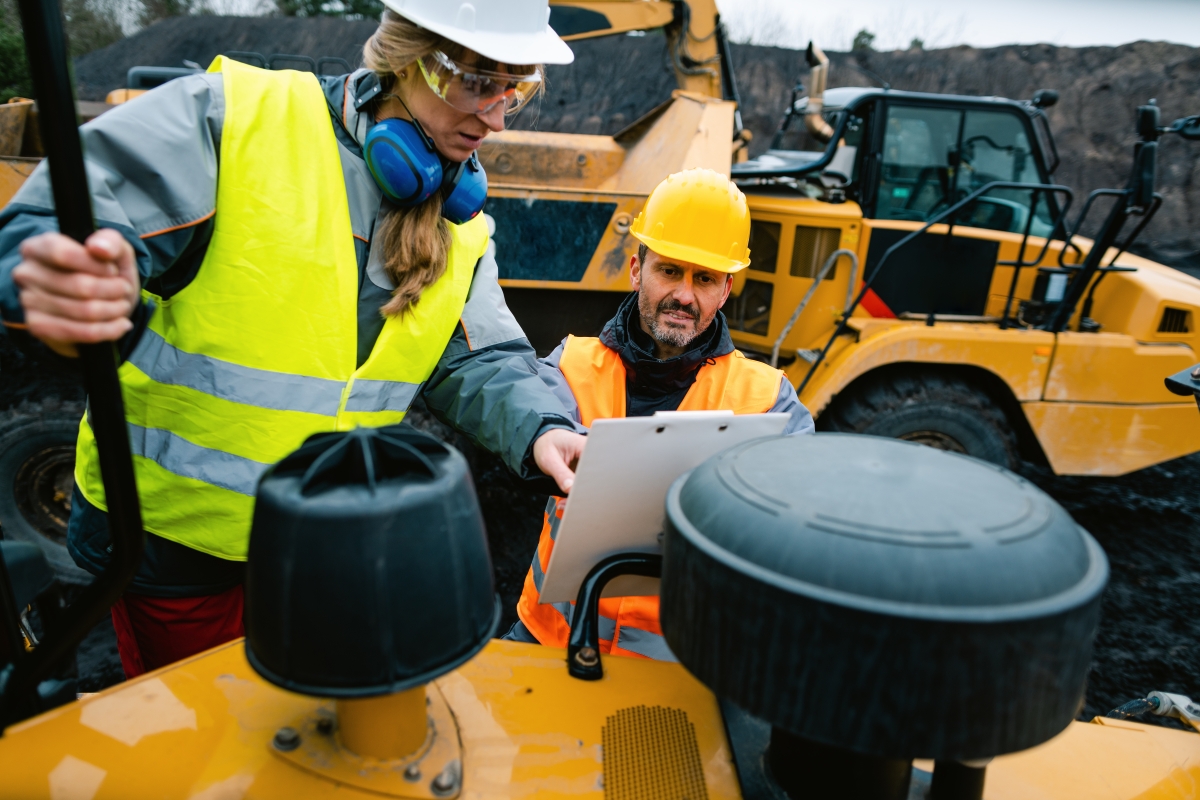
Drillers and blasters - surface mining, quarrying and construction
Career Overview
Drillers and blasters (surface mining, quarrying and construction) work for mining, quarrying and construction companies, and drilling and blasting contractors. This work includes construction, tunnelling, demolition and avalanche control.
Drillers operate mobile drilling machines to bore blast holes in open pit mines and quarries, and for building foundations at construction sites.
Blasters fill blast holes with explosives and detonate explosives to dislodge coal, ore, rock or to demolish structures.
Job Titles
Duties
Drillers:
- Operate tracked or truck-mounted rotary drilling, air-track or other drilling machines to bore blast holes in open-pit mines or quarries
- Run drilling machines to drill blast holes in rock at road or other construction sites
- Operate tracked or truck-mounted drills equipped with an auger or other attachments to drill holes for building foundations or pilings
- Operate support equipment, stoper or jackleg drills and use hand and power tools
- May measure and stake out patterns of holes to be drilled, load blast holes with explosives and detonate explosives to dislodge coal, ore or rock
- May stage (safeguard work areas), scale (dislodge) loose rock or conduct lift operations
Blasters:
- Read instructions or diagrams, lay out drill patterns and determine the depth and diameter of blast holes
- Run field tests to determine the type and quantity of explosives needed
- Assemble or direct other workers to assemble primer charges using detonators, fuses, detonating cords and other materials
- Load explosives in blast holes by hand or direct bulk explosives trucks to load blast holes
- Connect electrical wires, detonating cords or fuses into series (of holes) and connect the series to blasting machines
- Detonate the charges
- Handle, store and transport explosives and accessories to meet regulatory and safety procedures
- May operate air-track, rotary, down-the-hole or other drilling machines to drill blast holes
- May direct other workers to drill blast holes
Drillers and blasters often do both drilling and blasting.
Earnings
Earnings is income that workers receive in exchange for their labour. Depending on the type of employment, earnings can be in the form of wages (hourly), salaries (fixed monthly or annual) or self-employed earnings.
Work Environment
# Workers Employed
645% Employed Full Time
47%Work takes place outdoors, so workers may be exposed to a variety of weather conditions. Work may also be done from inside heavy equipment, such as drilling machines.
Working with explosives in dangerous locations and exposure to flying particles and falling objects pose risk of injury. Working with equipment, instruments and power or hand tools may also be a potential source of injury. Loud noises in the workplace can affect hearing. Workers must take safety precautions to reduce the risk of injury.
Career Pathways
Progression to supervisory positions is possible with experience. Workers may also be able to move laterally into other jobs within the mining and construction industries.
Occupational Interests
It’s important to understand what kinds of occupations align with your interests.
For more about occupational interests visit Skills for the Future Workforce > Characteristics.
Here are the top occupational interest(s) for this career profile:

Education, Training and Skills
Drillers and blasters may begin as a drilling helper or blaster’s assistant or use transferrable skills from equipment operation. A secondary (high) school certificate is usually required.
Drillers:
Employers provide on-the-job training. This includes learning to use drilling equipment as well as operating heavy or support equipment such as track dozers, production loaders and utility vehicles.
Blasters:
All blasters working in B.C. must be certified. To become certified, blasters must provide documentation supporting their practical competency and pass a written exam administered through WorkSafeBC.
There are different certifications for different kinds of blasting work, such as mining, avalanche control and pyrotechnics.
WorkSafeBC recognizes blasting certificates issued in other Canadian jurisdictions. Blasters with out-of-jurisdiction certificates can be issued a WorkSafeBC blasting certificate. Criteria include:
- Certificates must be valid and up to date. Certificates issued by WorkSafeBC will expire on the same date as the out-of-jurisdiction certificate or in five years, whichever occurs first. Certificates with no expiry date are acceptable; however, certificates issued by WorkSafeBC will only be valid for up to five years and may be endorsed with any restriction that WorkSafeBC deems necessary.
- The out-of-jurisdiction blasting certificate must have been required by a Canadian government body or regulatory authority or issued by a training and certification provider recognized by the Canadian government body or regulatory authority in the issuing jurisdiction.
- The scope of activities covered by the out-of-jurisdiction blasting certificate must be similar to the blasting codes recognized by WorkSafeBC's blasting certification scheme.
For those who trained outside of Canada and never received certification from any Canadian jurisdiction, a full assessment is likely needed. Most occupational regulators have a process for assessment and recognize internationally trained applicants.
Contact the WorkSafe BC for details on how to apply for certification in B.C.
For information about labour mobility in Canada, visit www.workersmobility.ca.
View a list of Professional Regulatory Authorities in B.C.
Education programs in B.C.

Top Skills
Every job calls for a certain set of skills. Knowing those skills is the first step in finding a good career fit.
Here, you will find the 10 most relevant workplace skills. Some are more important to achieving success in a certain career than others. These skills may come naturally to you or you may need to gain them through education, training and experience.
See the list of work-related skills below, ranked in order of importance for this career. Check out the list and see if this career matches your skills—take that first step!

Watching gauges, dials or other indicators to make sure that a machine is working properly.

Controlling operations of equipment or systems.

Giving full attention to what other people are saying, taking time to understand the points being made, asking questions as appropriate, and not interrupting at inappropriate times.

Keeping track of and assessing your performance, other individuals, or organizations to make improvements or take corrective action.

Using logic and reasoning to identify the strengths and weaknesses of alternative solutions, conclusions or approaches to problems.

Considering the relative costs and benefits of potential actions to choose the most appropriate one.

Being able to solve novel, ill-defined problems in complex, real-world settings.

Talking to others to share information effectively.

Managing one’s own time and the time of others.

Adjusting actions in relation to others' actions.
Labour Market Statistics
Discover data, facts and information that have been gathered and analyzed. Learn about the characteristics of the economy and labour market in B.C.
Employment
Find out about employment types and trends by region and industry.
Employment
645Employment by Region

| Region | Employment | % Employment of this Occupation |
|---|---|---|
| Cariboo | 35 | 5.4% |
| Kootenay | 25 | 3.9% |
| Mainland/Southwest | 200 | 31.0% |
| North Coast and Nechako | 30 | 4.7% |
| Northeast | 10 | 1.6% |
| Thompson-Okanagan | 140 | 21.7% |
| Vancouver Island/Coast | 215 | 33.3% |
Labour Market Outlook
The B.C. Labour Market Outlook is a 10-year forecast of the expected supply and demand for labour in the province. It’s usually updated every year. The purpose is to provide British Columbians with the knowledge to make informed decisions on careers, skills training, education and hiring.
Forecasted Job Openings (2025-2035)
180Forecasted Job Openings
Forecasted Employment Growth Rate
Composition of Job Openings
Job Openings by Region (2025-2035)
| Region | Job Openings | Avg. Annual Employment Growth |
|---|---|---|
| Cariboo | 0 | -1.1% |
| Kootenay | 10 | 0.5% |
| Mainland/Southwest | 40 | 0.4% |
| North Coast and Nechako | Not available | Not available |
| Northeast | Not available | Not available |
| Thompson-Okanagan | 50 | 1.3% |
| Vancouver Island/Coast | 70 | 0.8% |
Industry Highlights
Learn about the opportunities in B.C.'s major industries, including employment trends, earning potential, locations of work and more.
Forecasted Job Openings by Industry
| Industry | Job Openings (2025-2035) |
|---|---|
| Construction | 110 |
| Mining and Oil and Gas Extraction | 70 |
| Forestry, Logging and Support Activities | 10 |
Resources
-
British Columbia Construction Association (BCCA)www.bccassn.com
-
Centre of Training Excellence in Mining (CTEM)www.bc-ctem.ca
-
Institute of Makers of Explosives (IME)www.ime.org
-
International Society of Explosives Engineers (ISEE)www.isee.org
-
Mining Needs You – production drillerminingneedsyou.ca/career/production-driller
-
Transport Canada – Transportation of Dangerous Goodswww.tc.gc.ca/eng/tdg/safety-menu.htm
-
WorkSafeBC – blaster certificationwww.worksafebc.com/en/health-safety/education-training-certification/blasting